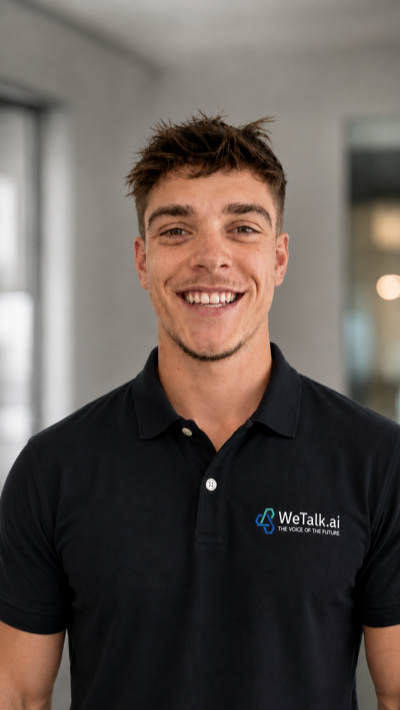
Hamish has had three knee surgeries. Ollie's had two shoulder reconstructions. Add in years of representative sport, right through to provincial and national level, and physios have been part of our lives since we were kids.
When you need a physio urgently, you don't want to click through a booking website. You want to ring, tell someone what's wrong, and get seen. We both know that from the other side of the phone. When AI voice technology got good enough to hold a real conversation, we put two and two together.
We built the first version ourselves, from a laptop in a flat in Dunedin. It worked, right up until we connected it to a real booking system, and then it fell apart. We got it as far as we could on our own, then brought in Darcy Knox, an experienced software engineer who used to coach us both at basketball through high school and into Otago's rep teams. We messaged him, met at a cafe in Dunedin, and handed him the prototype. That was 10 months ago. He took it from something that worked in theory to something clinics could actually run on, and we've worked on Jenny every day since.
Voice AI is genuinely new technology, and when we started, getting a natural conversation and a correct booking every single time was hard. So we ran a proper research and development stage. We live-tested Jenny in a clinic, on real calls with real patients, and used what we learned to take her back into the workshop and rebuild her around it. The technology has come a long way since we began, and so has she. Jenny is now live in two clinics, one of them the Dunedin practice Hamish goes to himself. We know what "good enough" looks like because we're patients too.
That rebuild wasn't done in a vacuum. Every version of Jenny has been shaped by physios — sitting in clinics, watching how the front desk actually runs, and listening to what practice owners, receptionists and physiotherapists across the New Zealand physio space told us they needed and what they wouldn't tolerate. She isn't a general-purpose AI receptionist pointed at physio. She has been built, from the ground up, for New Zealand physio clinics.
The moment we knew it was working: a clinic asked us to turn Jenny on full time.
Think about how it actually goes. You do your knee on a Saturday, and you sit on it until Monday morning so you can ring the clinic the second it opens, hoping someone picks up before the day fills. You don't want to click through a website hunting for a free slot, and you don't want to leave a voicemail and wait. You want to ring, find a time, and have the appointment booked on the spot. With Jenny, you ring when it happens. Saturday night, Sunday, six in the morning before work. You get booked there and then. She tells callers she's an AI up front — we think that's the only way to do this in healthcare.
We're not trying to replace your team. Jenny picks up the calls that would otherwise go to voicemail and sit there until someone has a spare moment the next day — after hours, the busy patches, the ones nobody gets to. That gives your reception team their time back for the person standing in front of them and the jobs that can't wait.